
30 September 2026
FPL Injuries: International Duty Is No Riskier Than a Gameweek
We're halfway through the longest international break of the season: a double window running from 24 September to 6 October, with Gameweek 6's deadline at 11:00 UK time on Saturday 10 October. Every break brings the same worry for Fantasy Premier League (FPL) managers: will my players come back injured?
This post does two things. First, it lists the players who have picked up an injury during this break. Second, it checks four seasons of data on how risky international duty really is. The short answer: playing for your country carries about the same injury risk as a normal week of Premier League football. It isn't the danger it's often made out to be, but it isn't a rest either.
Who's been injured during this international break
These 8 players were fit when the break started and have been given an FPL injury flag since. Data as of 30 September, before this window's second pair of internationals (1–6 October).
| Player | Club | FPL news | Flagged | Owned | What happened |
|---|---|---|---|---|---|
| Isak | LIV | Thigh injury, 75% | 27 Sep | 22.4% | Played for Sweden |
| Semenyo | MCI | Ankle injury, 75% | 24 Sep | 15.3% | Didn't play for his country |
| Gakpo | LIV | Ankle injury, 75% | 27 Sep | 12.4% | Played twice for the Netherlands |
| Havertz | ARS | Hamstring injury, 75% | 24 Sep | 8.3% | Played for Germany |
| Brobbey | SUN | Hamstring injury, 75% | 24 Sep | 7.0% | Played for the Netherlands |
| Ballard | SUN | Hamstring injury, 75% | 25 Sep | 2.5% | Didn't play for his country |
| Dorgu | MUN | Hamstring injury, 75% | 27 Sep | 0.5% | Played twice for Denmark |
| Gittens | CHE | Ankle injury, 75% | 26 Sep | 0.0% | Played for England U21 |
All eight are FPL's "75% chance of playing", so they're doubts rather than confirmed absences. Expect clearer news at the clubs' press conferences before the deadline. Semenyo and Ballard are both internationals who haven't played for their countries this window. That pattern is worth noticing (see below): internationals who miss their country's games are often already carrying something.
What stands out:
- Six were flagged after playing for their country, out of about 210 (under 3%). That's how many Premier League players have played at least one international so far this window (around 190 for senior national teams, the rest for under-21 sides). Over past breaks, 4.6% of players who played for their country were flagged by the next deadline, so with two match days left this break looks ordinary, not unusually bad.
- Many more flags came from Gameweek 5, not the break. Another 17 players were flagged between the GW5 deadline and the first internationals, including Palmer (CHE) and Rice (ARS) after 90 minutes each. Those injuries happened in the Premier League.
- So far this break, 6 of 202 fit regulars (3.0%) have a new flag. Two match days remain, so that will rise. For comparison, across past breaks about 5% of fit regulars had a new flag by the first deadline after the break (below).
How risky is international duty?
The worry: international breaks send players off to extra matches, long flights and unfamiliar training, and they come back hurt. We checked the four seasons from 2022/23 to 2025/26.
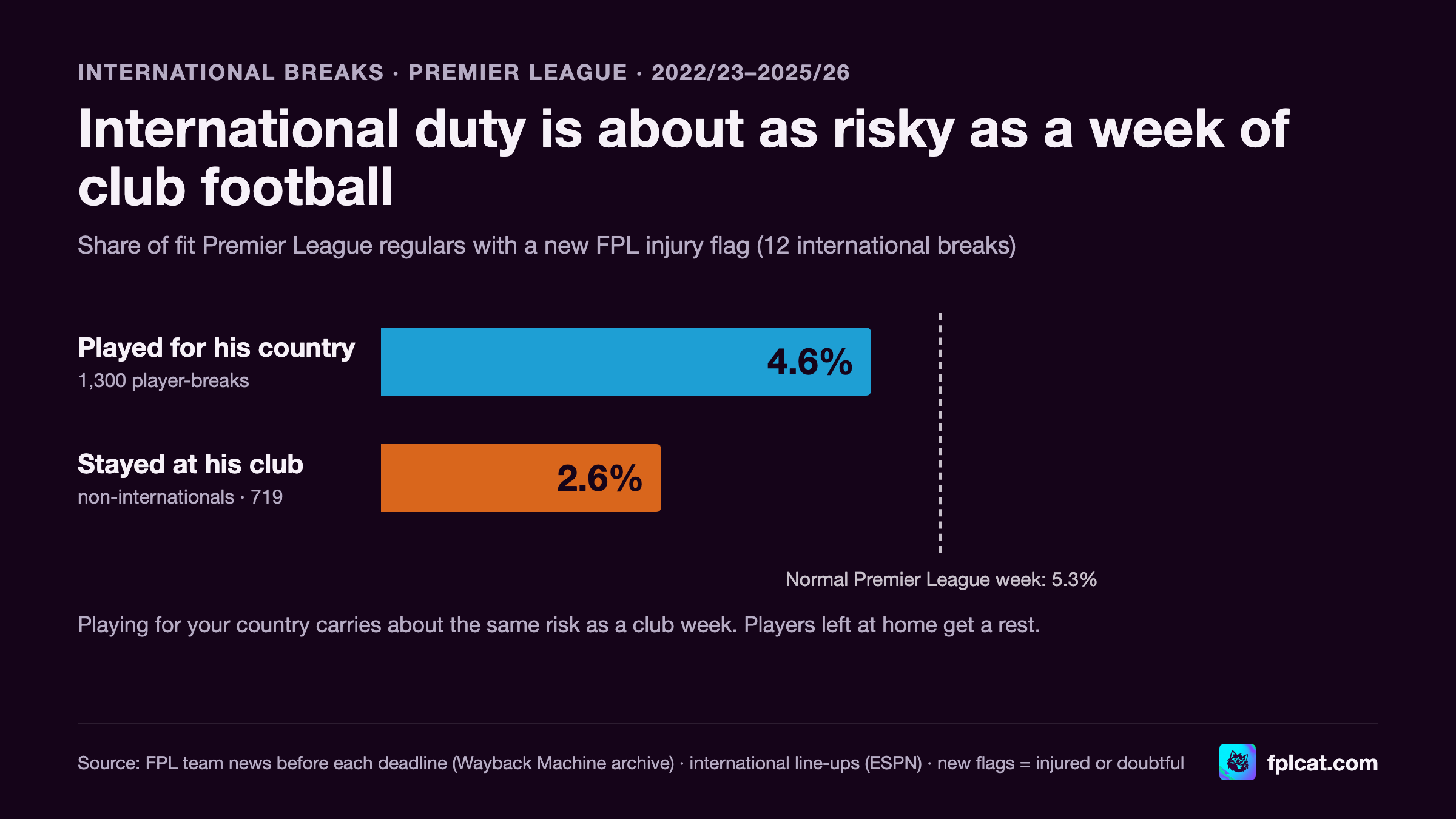
Across 12 international breaks, among Premier League regulars who were fit when the break started:
| Group | Player-breaks | New injury flags | Rate |
|---|---|---|---|
| Played for his country during the break | 1,300 | 60 | 4.6% |
| A normal Premier League week | 23,842 | 1,254 | 5.3% |
| Stayed at his club during the break (non-internationals) | 719 | 19 | 2.6% |
A player-break is one player in one break: a player who was fit before 10 of the 12 breaks counts 10 times, once per break. The normal-week row counts one player in one gameweek the same way.
Three things follow:
- International duty is roughly as risky as club football. 4.6% of players who played for their country picked up a new flag by the first deadline after the break, against 5.3% in a normal Premier League week. Internationals aren't especially fragile either: in normal weeks they're flagged at the same rate as everyone else (5.2% vs 5.3%).
- Staying at home is the safer option. Regulars who never play international football and spend the break at their clubs were flagged at 2.6%. So players on duty are about 1.75 times as likely to be flagged as those who rest (the likely range is roughly 1.05 to 2.9). Two weeks without a competitive match is simply lower risk than playing one or two.
- Internationals who miss their country's matches are the real red flag. 19% of fit-looking internationals who didn't play during a break had a new flag by the next deadline (38 of 197). The likely reason: many had pulled out of their squads with a knock that FPL only listed later, at the club's press conference.
Why does it feel like everyone comes back injured?
Measured from the last deadline before a break to the first one after it, 7.8% of fit regulars pick up a new flag, against 5.3% in a normal week. Most of that gap isn't international football:
- A break is two weeks, not one. Two-week gaps without internationals (the winter break, FA Cup weekends) show almost the same rise: 7.0%.
- Injuries from the last club match surface during the break. A player hurt on the Saturday before the break pulls out of his national squad, then appears in the club's press conference ten days later. It looks like a break injury, but it happened in the Premier League. This break's list shows it: 17 of the 25 players newly flagged since the Gameweek 5 deadline were flagged before the first international was played.
- Two weeks of news lands at once. Flags that would normally trickle out across two gameweeks all arrive before one deadline.
How we tested it
- Injuries: FPL's own team news. We used archived copies (from the Wayback Machine) of FPL's player data at every deadline since 2022/23, plus one on the Wednesday of each break: each player's status, chance of playing and news text. A new injury flag means a player who was fully available at one snapshot is marked injured or doubtful at the next with an injury-type reason: injury, knock, illness or unknown. Suspensions, loans, "lack of match fitness" and Africa Cup of Nations / Asian Cup call-ups (listed by FPL as "International Duty") don't count.
- Who played for their country: line-ups of 3,067 national-team matches (senior and youth, every confederation) from ESPN, matched to FPL players by name.
- Players: Premier League regulars only, meaning they started at least two of their club's last four league matches. They also had to be fully fit at the start.
- The break itself: the clock starts on the Wednesday of each break, after the last club matches and before the internationals, and stops at the next FPL deadline. That keeps injuries from the last club round out of the comparison.
- The stay-at-home group only includes players who didn't play for their country at any point that season. Internationals who miss a break are excluded from it, because many of them are carrying knocks FPL hasn't flagged yet (the 19% above), which would make staying at home look far riskier than it is.
- Breaks covered: 12 of the 14 breaks from September 2022 to March 2026. September 2022 and October 2024 are missing because an archived snapshot is missing at one end.
The caveats
- Flags aren't diagnoses. "75% chance of playing" covers everything from a precaution to a real problem, and news appears when clubs choose to publish it.
- The groups aren't identical. Non-internationals are, on average, less prominent players. But in normal weeks they're flagged at the same rate as internationals, so the difference during breaks isn't about who they are.
- The 2022 World Cup is too small a sample to say much. Of the 76 Premier League regulars who played at the tournament, 3 came back with a new flag, against 8 of 88 non-internationals who stayed.
- Around 1,300 player-breaks is enough to spot a large effect, not a small one. The comparison with a normal club week (4.6% vs 5.3%) can't rule out a small difference in either direction.
What it means for your FPL team
- Don't sell a player just because he's away with his country. The risk is about the same as a normal gameweek.
- Watch for players who miss their country's matches. If a regular international sits out or pulls out, treat it as a warning sign before the deadline.
- Check the news before the deadline. Many of the flags that matter this break came from Gameweek 5, and the clubs' press conferences in the days before the deadline will update most of the 75% flags above.
- Watch the second match days (1–6 October) for Isak, Gakpo and Havertz, who are already flagged after playing for their countries. We'll update this list before the deadline.
When Gameweek 6 kicks off, follow FPL bonus points live: every player's BPS, provisional bonus and points breakdown, updated during the matches, so you'll see straight away whether the flagged players above started and how long they lasted. FPL DEFCON live does the same for defensive contribution points. For planning beyond Gameweek 6, the fixture difficulty ratings show who has the kindest run after the break.
More FPL strategy
- Fulham: An FPL Team to Watch Before Their Two Easiest Fixtures of the Season
- FPL DEFCON Midfielders: 16 with Attacking Returns (GW1–5)
- How FPL Bonus Points Work: The BPS Explained (2026/27)
- What the Top 100 FPL Managers Did Differently: The Elite Template After GW5
- Inside the World's #1 FPL Team: Every Chip, Every Transfer, Gameweek by Gameweek
- Should You Buy Pascal Groß in FPL? Not Yet — Here's Why
- Welcome to FPL Cat
- Fantasy Premier League Fixture Difficulty Ratings: What They Do (and Don't) Tell You